| |
|
|
BIRD FAMILIES OF THE WORLD |
20th edition
list last revised December 2025
this list has 255 extant families
|
|
|
My Bird
Families of the World has aimed to be an aid to world birders who
want to enjoy avian diversity by seeking out members
of as many bird families as is reasonable within the time and money
available for travel. It provides a study tool for anyone. This project began in 1999. Since then, molecular evidence has revised our knowledge about bird evolution and relationships.
It was a wild ride for nearly two decades as new research was published, old traditional families were split into dozens, and new families discovered. Throughout those decades, I've advocated for better consistency in the use of evidence across bird families. Now, in 2025, a much higher degree of consensus has been reached between the various world checklists, and a global effort has produced a single consensus checklist called Avilist (2025). The first version of Avilist states it has 252 families, but one is the extinct Mohoidae, the last of which (Kauai Oo) disappeared after 1987. That means, for the purposes of world birders, Avilist has 251 extant families. The Avilist project intends to produce a revised checklist annually. However, for 2025, the final Clements Checklist further merged Spindalidae and Nesospingidae into the Phaenicophilidae, created a new Caribbean Tanagers family. Accordingly, after dropping the extinct Mohoidae, Clements (2025) has 249 extant families.
This update, called the 20th edition, provides revisions to my prior editions. This is because the current set and sequence of bird families has become more or less stabilized after two decades of genetic research. I've moved closer to Avilist and Clements, and now follow their revised sequence of Orders and Families. I still differ from Avilist and Clements on some Family level decisions. I have followed Avilist on some decisions, but not in every instance. My list of bird families is now at 255 extant families. A discussion of revisions for this 20th edition follows the list of Bird Families and links to separate pages for each Family
|
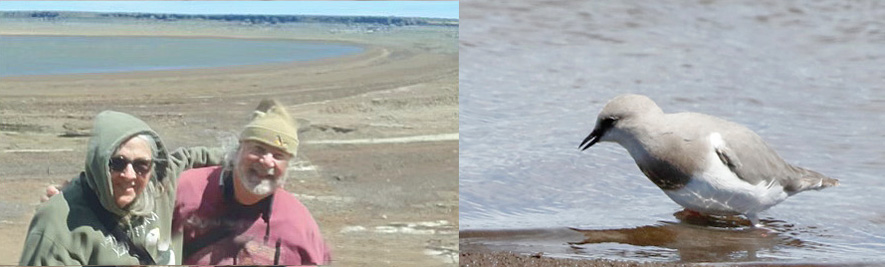
| This project was not entirely academic. Another purpose was personal: to help me structure our travel in search of a still-living member of every bird family. I could average about one foreign birding trip a year, and I wanted to make sure that we would try to find all those birds that might be split at the Family level. It took 40 years but, on 15 Nov 2022, at this shallow lagoon on the Stoebel Plateau in Patagonia, Argentina (below left), with cold glacierial winds howling at 40 knots (we are physically leaning into the wind), my wife Rita Carratello and I saw my final bird family: Magellanic Plover (below right). Absent unexpected future taxonomic revisions, I've now seen a member of every bird family still existing on Earth. |
 |
Set out below is a taxonomy of the Bird Families of the World, with links to a separate page for each bird family. You'd have to check out 255 pages to see photos of every bird family.
Alternatively, you can view at least one photo of at least 236 families in my personal bird family gallery. The final pages of that gallery include "prior familes," "proposed families," and a set of 30 extra favorite photos
|
|
|
In putting together this project, over various editions, I've been influenced by the Winkler et al. Bird Families of the World book (2015), the Handbook of the Birds of the World (HBW) project and continuing Birdlife International lists, updated decisions of the eBird/Clements world checklist, the IOC world checklist, the American Ornithological Society's Check-list of North American Birds for Middle and North America (often called the AOU or AOS list in these pages), the South American Classification Committee checklist, and John Boyd's Avian Taxonomy in Flux. Books include Christidis & Boles (2008) Systematics & taxonomy of Australian Birds and the Howard & Moore Checklist (4th ed., 2 vols).
[Full disclosure — I was a volunteer junior member of the Clements team (2011-2018) but I continue to depart from Clements for purposes of this project.] |
|
|
|
|
|
|
|
| |
HIGHTLIGHTS OF CHANGES in this 20th edition (2025)
I follow Avilist in merging the monotypic Yellow-breasted Chat into the Icteridae [New World Orioles and allies]. I have advocated for that change in prior version of this checklist. I believe that the divergence of just ~11 mya is too recent, especially compared to Old World passerines which tend to be elevated to Family level at something greater than ~18-20 mya. I follow Clements (2025) in merging the "Spindalidae" (genus Spinadlis) and the Puerto Rican Tanager (genus Nesospingus); "Nesospingidae"), which diverged about 10-12 million years ago (e.g., Barker et al. 2013), are better classified as members of the Phaenicophilidae. In addition, recent research suggests that Cinnamon Ibon (Hypocryptadius cinnamomeus) is not as ancient as previously believed (e.g., Fjeldså et al. 2010), and I now follow Avilist and Clements in considering the Ibon to be an early offshoot of the Passeridae. Finally, following Avilist, I merge the "Alcippeidae" (i.e., the Alcippe Fulvettas) into into the Leiothrichidae. Cai et al. (2019) has proposed this split but it has not been widely adopted. These decisions reduce my Family total from 260 Families to 255 extant Families.
I continue to maintain a few Families that Avilist has either merged or has not yet adopted. Avilist merges Bucorvidae [Ground Hornbills] into Bucerotidae [Hornbills] on genetic data that suggest clade ages may be over-estimated, and "obvious morphological affinities with other hornbills". I disagree. The genetic evidence is preliminary, and Avilist acknowledges that ground hornbills form "a divergent clade." Unlike all other hornbills, ground hornbills do not seal the female inside a nest cavity; they walk instead of hop; they lack a carotid artery (unique among all birds); and they have 15 instead of 14 neck vertebrae (Kemp 1995). As to "obvious morphological affinities with other hornbills," Avilist and Clements have four (4) Families of parrots, despite ""obvious morphological affinities with parrots" assigned to other parrot Families. Ground Hornbills are an exceedingly unique group, ancient and worthy of Family status. I continue to consider them a separate Family from the other hornbills.
I continue to maintain the Elanidae, following Starikov & Wink (2020) who opine, based on molecular evidence, that "mitochondrial and nuclear markers . . . combined with morphological, cytogenetic, and ecological date" warrant the elevation of the Elanin kites to family Elanidae. These involve the Elanus and Chelictinia kites, and Pearl Kite Gampsonyx swainsonii. Their data suggest these kites diverged from the rest of Accipitridae ~21 million years ago, similar to the divergence of many of the Families among the Charadriiformes. The Avilist team is reviewing the proposal. Likewise, I maintain the Eurocephaliidae [White-crowned Shrikes], proposed as a Family by Fuchs et al. (2019), which Avilist has not yet reviewed. These two Families have been recent proposals, so world birders should make an effort to focus on these groups
Finally, I continue to maintain the Pteruthiidae [Shrike-babblers], Erpornithidae [Erpornis], and Lamprolidae [Silktails] as Families, each of which are an ancient clade (see Jønsson et al. 2016), diagnostically distinctive from relatives, and have been proposed for Family status for some time. Accordingly, at the end of 2025, Clements (2025) had 249 extant Families, Avilist had 251 extant Families, and my 20th ed. list (here) has 255 extant Families. There are a few English name changes: the Erythrocercidae, which I had called "Bristle-Flycatchers," are now called Yellow Flycatcher by Avilist. The monotypic Urocynchramidae is called "Przevalski's Finch" by Avilist, but I much prefer to call it Pinktail, a distinctive name for a Family level taxon, and much easier to say. |
|
Literature cited in this introduction:
Barker, F.K., A. Cibois, P. Schikler, J. Feinstein, and J. Cracraft. 2004. Phylogeny and diversification of the largest avian radiation. Proc. Natl. Acad. Sci. 101: 11040–11045.
Barker, F.K., K.J. Burns, J. Klicka, S.M. Lanyon, and I.J. Lovette. 2013. Going to extremes: contrasting rates of diversification in a recent radiation of New World passerine birds. Syst. Biol. 62: 298–320.
Burns, K.J., A.J. Schultz, P.O. Title, N.A. Mason, F.K. Barker, J. Klicka, S.M. Lanyon, and I.J. Lovette. 2014. Phylogenetics and diversification of tanagers (Passeriformes: Thraupidae), the largest radiation of Neotropical songbirds. Molec. Phylog. Evol. 75: 41-77.
Cai, T., A. Cibois, P. Alström, R.G. Moyle, J.D. Kennedy, S. Shaoh, R. Zhang, M. Irestedt, P.G.P. Ericson, M. Gelang, Y. Qu, F. Lei, J. Fjeldså. 2019. Near-complete phylogeny and taxonomic revision of the world’s babblers (Aves: Passeriformes). Molec. Phylog. Evol. 130: 346-356.
Fjeldså, J., M. Irestedt, P.G.P. Ericson, and D. Zuccon. 2010. The Cinnamon Ibon Hypocryptadius cinnamomeus is a forest canopy sparrow. Ibis doi: 1111/j.1474-919X.2010.01053.x
Fuchs, J., P. Alström, R. Yosef, and U. Olsson. 2019. Miocene diversification of an open-habitat predatorial passerine radiation, the shrikes (Aves: Passeriformes: Laniidae). Zoologica Scripta 48: 571–588.
Jønsson, K.A., P-H. Fabre, J.D. Kennedy, B.G. Holt, M.K. Borregaard, C. Rahbek, and J. Fjeldså. 2016. A supermatrix phylogeny of corvoid passerine birds (Aves: Corvides). Molec. Phylog. Evol. 94: 87-94.
Kemp, A. 1995. Bird Families of the World: The Hornbills (Bucerotiformes). Oxford Univ. Press, Oxford.
Ohlson, J.I., M. Irestedt, P.G.P. Ericson, and J. Fjeldså. 2013. Phylogeny and classification of the New World suboscines (Aves, Passeriformes). Zootaxa 3613: 1-35.
Prum, R.O., J.S. Bery, A. Dornburg, D.J. Field, J.P. Townsend, E.M. Lemmon, and A.R. Lemmon. 2015. A comprehensive phylogeny of birds (Aves) using targeted next-generation DNA sequencing. Nature 526: 569–573.
Schodde, R., and L. Christidis. 2014. Relicts from Tertiary Australasia: undescribed families and subfamilies of songbirds (Passeriformes) and their zoogeographic signal. Zootaxa 3786: 501-522.
Starikow, I.J., and M. Wink. 2020. Old and Cosmopolite: molecular phylogeny of tropical–subtropical kites (Aves: Elaninae) with taxonomic implications. Diversity 12: 327–342.
Winkler, D.W., S.W. Billerman, and I.J. Lovette. 2015. Birds Families of the World: A Guide to the Spectacular Diversity of Birds. Lynx Edicions, Barcelona.
|
HIGHTLIGHTS OF CHANGES in the 19th edition (2024)
I make only one family changes in this 19th edition. The addition is family Salpornithidae, the Spotted Creepers. Further, I've resequenced the list of bird families to follow the current 2024 Clements checklist. There are a few minor changes in sequence among Non-passerines, particularly affecting Flamingos and Grebes, but none (except to add the Spotted Creepers) in the Passerines.
My 18th edition, posted one and-a half years ago, also added just one family, the Elanidae, following Starikov & Wink (2020) who opine, based on molecular evidence, that "mitochondrial and nuclear markers . . . combined with morphological, cytogenetic, and ecological date" warrant the elevation of the Elanin kites to family Elanidae. These involve the Elanus and Chelictinia kites, and Pearl Kite Gampsonyx swainsonii. Their data suggest these kites diverged from the rest of Accipitridae ~21 million years ago. This divergence date is quite similar to divergence dates in families within the Charadriiformes, for example (see Cerny & Natale 2022 for one recent time-dating hypothesis).
The deletion is to follow Christidis & Boles (2008), and all updated global checklists, in merging the Australo–Papuan Butcherbirds and allies into the woodswallow family Artamidae. Behaviorally, woodswallows (genus Artamus) and the two peltops (Peltops) are distinctive sit-and-wait predators of flying insects, compared to the more corvid-like omnivores — characteristics that make them easily separable — but a series of studies have shown that together they are a strongly supported clade within the Corvoidae (summarized in Winkler et al. 2015). In 2025, the SACC was the last current significant checklist to more Skimmers to a subfamily of the Laridae. They previously had listed it as a Family. I follow that decision, and now consider the Rynchopinae a subfamily.
Net result: no net change in total families from the 18th edition [still 260 extant families]
|
The newest Bird Families book [Winkler et al. 2015] had 243 families. My list in this edition has 25 families, 12 more than the Bird Families book: Ground-Hornbills, Elanin Kites (Starikov & Wink 2022), Old World Parrots & Lories [Psittaculidae; also split by Clements, IOC, AOU, SACC], Sharpbill [Oxyruncidae; split by SACC, Clements], Royal Flycatchers [split by AOU, IOC], Shrike-babblers and Silktails [both splits recommended by Jønsson et al. (2016) on evidence of ancient divergences], Erpornis, "Bristle-flycatchers" [Erythrocercidae; also split by Clements and IOC] are now generally called Yellow Flycatchers, White-crowned Shrikes (Fuchs et al. 2019), the Alcippe Fulvettas (Cai et al. 2019), Hylias (split by Clements & IOC), Wallcreeper [Tichodromidae; also split by Clements, IOC], Parrotbills & allies [Paradoxornithidae; also split by IOC and others], Cinnamon Ibon (based on ancient divergence), and the newest, the Spotted Creepers. In short, this list incorporates all of the extant families adopted by Clements, AOU, SACC, or IOC [except Bananaquit]. |
My listing is of extant bird families. The Mohoidae, an endemic family from Hawaii that included 5 species in genus Moho and one in genus Chaetoptila that had traditionally been considered honeyeaters in the Meliphagidae. Genetic evidence proved they were not honeyeaters, but that they were related to silky-flycatchers, waxwings, and other bombycillids. The Mohoidae is now extinct, so it is not possible to search for any of its members. The last remaining species was Kauai Oo, last proven alive in 1987, and now considered extinct. Thus, when comparing number of families between various list, it is important to use the list of extant families. Clements states this number explicitly; IOC apparently does not. |
|
HIGHLIGHTS
OF CHANGES in the 7th, 8th, 9th, 10th and 11th and 12th editions are now available through this separate link to the 12th edition (2012). The footnotes and citations in the 13th edition are now at a separate link to the 13th edition (2015).
|
|
This web project began on 9 Feb 1999 when I posted a short page on the Dulidae [Palmchat]. While the list of Bird Families has been regularly updated to accommodate new research through 17 editions, it was not until 17 years and a month [6238 days] that, with the posting of the Vireonidae [Vireos], this project finally had a web page with text and photos for every family. At that time, many of the old pages badly need updating in both layout, text, and photos but at least my initial goal had been reached. I've updated many old pages in the last few years, but some still need work. Pages with a white background are now old pages (more than a dozen years old) and badly need revision; pages updated 5-10 years ago have a light green background; pages with a forest green background (like this one) have been created or updated within the last half–decade. I've used my own photos when I had them, but I'm grateful to the many photographers around the world who've permitted me to use their wonderful shots when I needed them. – D. Roberson, 20 May 2021
|
|
This site is not affiliated with
the Handbook project but I highly recommend the books; click on
the banner below

|
|
Older essays, a long list of prior literature cited, and footnotes [now discontinued]
are found at the bottom of the 13th ed of this Checklist |
|
|
|
|
