These highlights chronicle the second half of year 2025. The year runs generally
"backwards" on this page. In crediting records of vagrant or unusual birds, I always try to credit the finder(s) of the rarity. There will be times when complications arise with credit (e.g., one or more observers find a bird but others are the ones to actually identify it). There are times when a bird is properly identified only days later after photo review.
These summaries are not meant to be a "complete" record of birds of interest in MTY in any season — the reports forwarded to the Seasonal Editors of North American Birds magazine are intended to fill that niche — but, rather, these pages are of highlights of a portion of the year that were documented, in most cases, with photos. As the creator of these pages grows older, the choice of bird highlights will become fewer.
The abbreviation "MTY" means "Monterey County"
in the text below. Text by Don Roberson. Photos on this page
are copyrighted by the photographers to whom they are
attributed, and may not be reproduced in any form (including
other web sites) without the express consent of the photographer. |
| |
 |
 |
 |
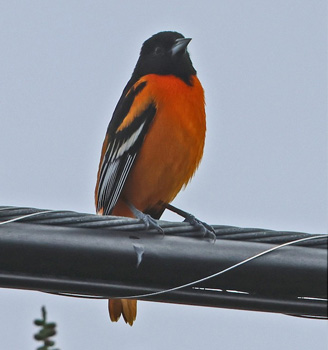 |
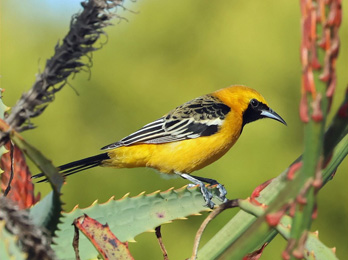
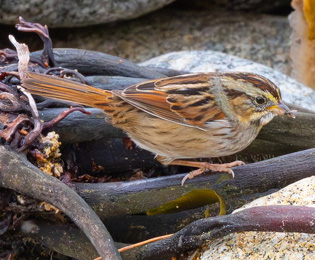
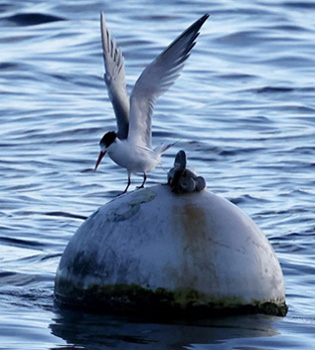
The Monterey Peninsula Christmas Bird Count (CBC) was held on 27 Dec 2025 during sunny but windy conditions. This year we enjoyed a day's end dinner and countdown in Pacific Grove, provided by Monterey Audubon, after five years of CBC countdowns by zoom during the Covid years. Our tentative CBC total was 186 species. Some highlights were (clockwise from upper left, all photos from 27 Dec unless otherwise stated):
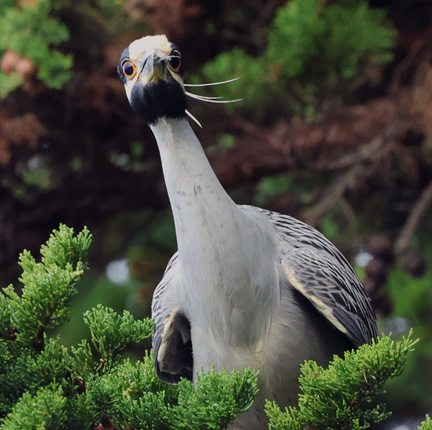
- Yellow-crowned Night Heron in Pebble Beach (© Rita Carratello), for its 3d winter, more below
- male Hooded Oriole in Monterey (© Don Roberson) in aloe at Dickman & Laine, present off-and-on from 4 Dec
- Swamp Sparrow near Yankee Pt. (© Karen Kreiger), back for a 2d winter; another wintering at Laguna Grande (Bill Hubick)
- Elegant Tern at Monterey harbor (© Steve Rovell) & Del Monte beach (Blake Matheson), and another at Pt. Pinos (Mark Kudrav)
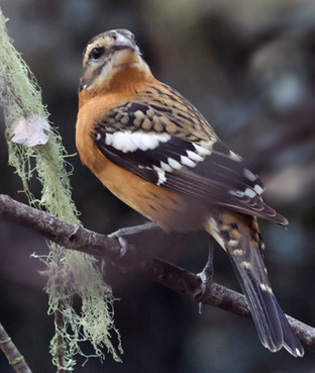
- imm male Black-headed Grosbeak in Pacific Grove yard (ph 20 Dec © Don Roberson), one of three in our yard from 23 Oct (this male), an imm female since 13 Nov (#2), and a 3d (19 Nov-15 Dec). This male and #2 were present into 2026
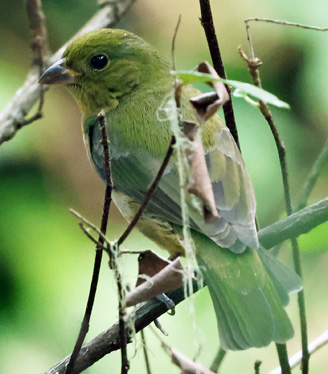
- Painted Bunting in Monterey, found by Jamie Hallock in Paul Jones' garden on count day (ph 30 Dec © Don Roberson), and then into 2026
- male Baltimore Oriole along Hawthorne St., Monterey, present with female since 25 Oct (Marty Freeman) into 2026 (ph 24 Dec © Don Roberson). The same two were briefly present in fall 2024, so these adults were back for a 2d year, and have lingered longer this winter
|
|
 |
|
|
Other notable birds on this year's CBC included over 3200 Pacific Loons, over 4600 Ancient Murrelet, a Fork-tailed Storm-Petrel off Seaside (Bill Hubick), the Tropical Kingbird wintering at Laguna Grande for its 7th year, a Cassin's Kingbird on Fort Ord NM (Terrence Degan), and a Nashville Warbler at Del Monte Lake, Monterey (Della Bossart).
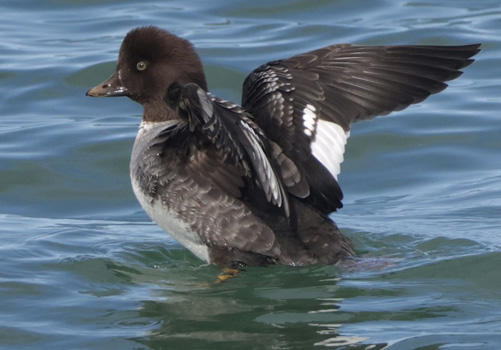
Missed on count day, but present during and after the CBC, were two Orchard Orioles, a female Baltimore Oriole, and a female Hooded Oriole (all in the Hawthorne neighborhood, Monterey), and on the ocean off Del Monte Beach, Monterey, this first-year female Barrow's Goldeneye (photo right, 24 Dec, © Kai Russell). |
| |
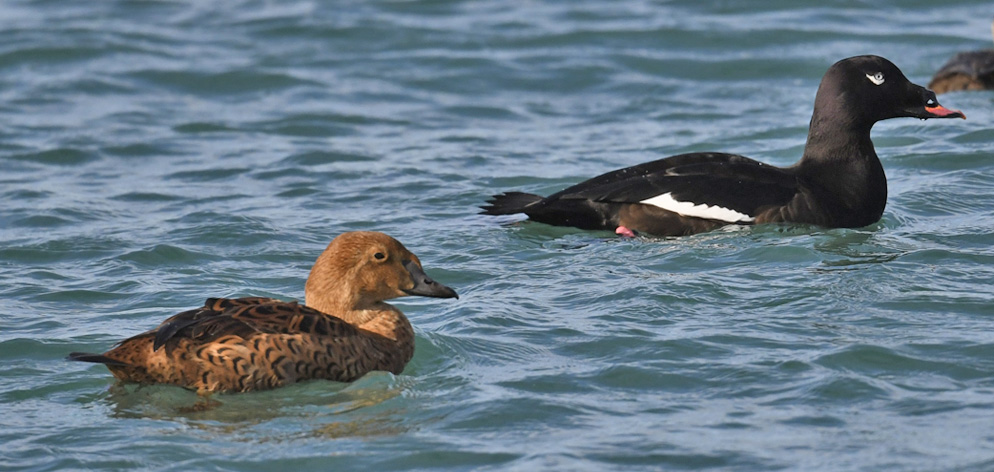 |
On 15 November, Steve Tucker discovered a female King Eider among the Surf Scoter flocks off the Moss Landing jetties. Initially, it foraged close to shore south of the south jetty, but during its two week stay (15-30 Nov) spent the latter half mostly north of the north jetty, where Cooper Scollan took this photo (above, 27 Nov, © Cooper Scollan). By the end of its stay a couple of White-winged Scoters and a Black Scoter were also present. Literally hundreds of observers came to see the eider, and many obtained fabulous photos, but I particularly liked this combination shot with a male White-winged Scoter.
The most prior recent King Eiders were off Asilomar SB in Pacific Grove from Feb-Apr 2023, and were likely a mother and a first-year young (see here). They were the 11th and 12th King Eiders in MTY. This is the 13th King Eider for the county. |
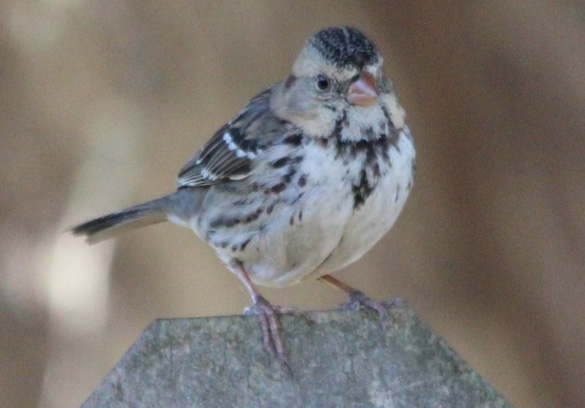
About a week after the King Eider disappeared from Moss Landing, Lisa Szuch discovered a first-winter Harris's Sparrow in the Moss Landing cemetery on 9 December (ph left, 9 Dec © Lisa Szuch). The sparrow was skittish and hit-and-miss to see, as it commuted from the cemetery to adjacent private yards with bird feeders. It lingered into January 2026.
This is the 23rd record for MTY, the vast majority appearing with other sparrows at backyard feeders in winter.
|
|
| |
 For the most part, fall migration in 2025 was considered "average" but warm and sunny days continued into December. This mild weather may have facilitated several unusual passerines to appear, or to linger very late in the autumn. For the most part, fall migration in 2025 was considered "average" but warm and sunny days continued into December. This mild weather may have facilitated several unusual passerines to appear, or to linger very late in the autumn.
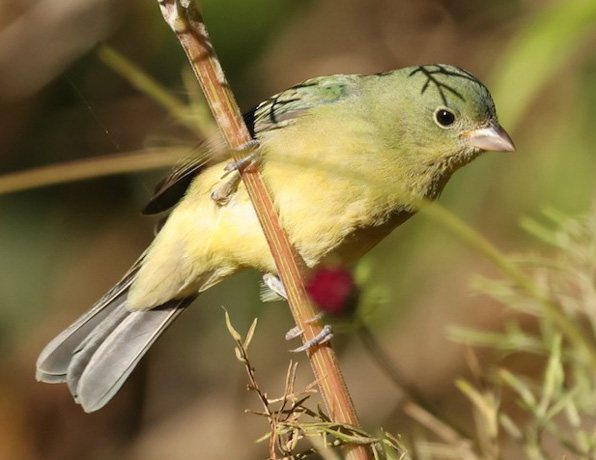
On 30 November, Steve Rovell discovered a hatch-year Painted Bunting in Marina (left, 30 Nov, © Steve Rovell). It was in a front yard that previously had hosted a White-winged Dove some years back. Many local birders successfully chased the rarity that same day, which was lucky because it was not seen thereafter. [Another hatch-year Painted Bunting appeared in late December, see above in the discussion of the CBC.]
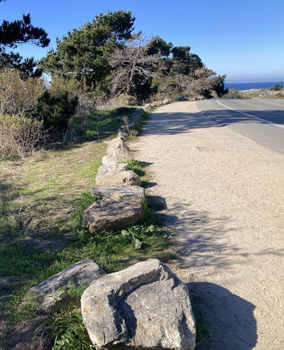
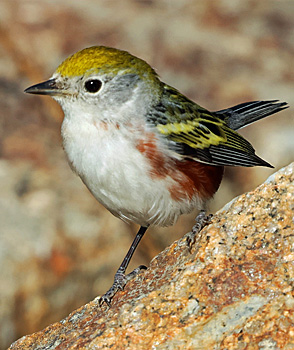
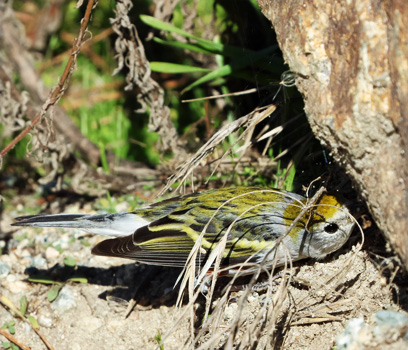
Even later was an unexpected and beautifully marked Chestnut-sided Warbler (below) in the dirt parking strip at the Majella Creek willow patch, across Sunset Drive from the south end of Asilomar conference grounds, Pacific Grove, from 7-11 December. Found by Linda & Steve Sargent, its behavior was most unusual. It spent its time foraging in crevices among a line of rocks demarcating the inner edge of the dirt parking lot (below, left). Occasionally it would hop up onto a rock (below, center ) but mostly around the base of each rock, eating termites (below right, all photos 8 Dec, © Don Roberson). |
|
|
| |
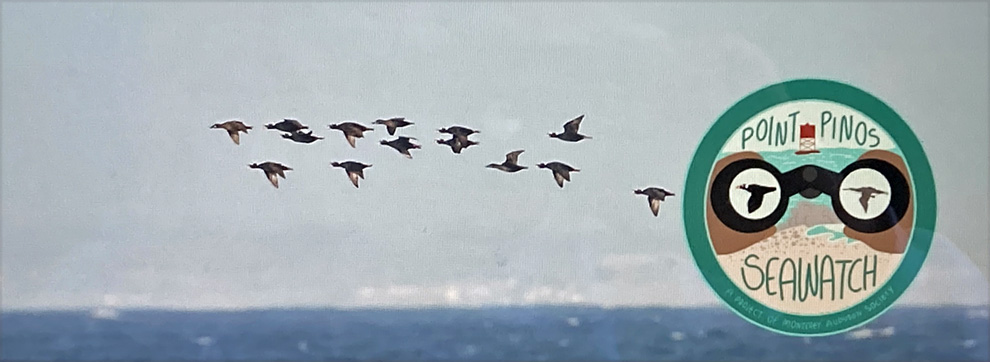 |
| There is now a permanent Monterey Audubon's Point Pinos Seawatch page full of seawatch stories, data, graphs, and photos. It provides much more than my short annual entries in this 10th year of the Seawatch. Alison Vilag was back as the professional bird counter at the Point for her 4th straight year. Her daily and entertaining blog is also accessed via the MAS Seawatch page. Alison was present from 1 Nov-15 Dec 2025, but local seawatchers almost daily survey from the Seawatch site early each morning. Much more information for public viewing from the Point is on the Pt. Pinos--seawatch Hotspot page. |
| |
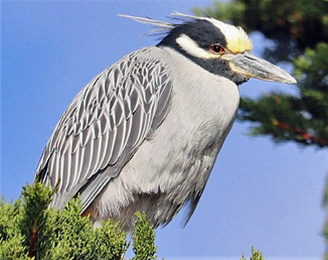
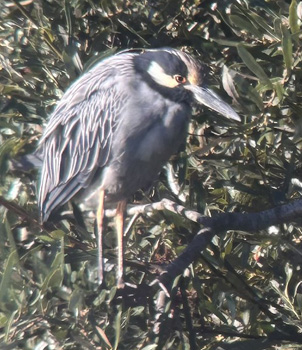 Our continuing Yellow-crowned Night Heron, having proven to be an adult male this summer by mounting a female Black-crowned Night Heron at Pt. Lobos in an attempt to breed (it was late in the season and the nesting attempt failed), continued his winter pattern of returning to the row of cypresses at Stillwater Cove, Pebble Beach, in November. After the Pt. Lobos breeding attempt, "Nick" showed up at Stillwater Cove from 5 August to 7 October, but then disappeared again for over a month. Just like last October, "Nick" appeared in the night-heron rookery at Elkhorn Ranch in Moss Landing! This was documented with photos on 11-12 October (photo right, 12 Oct, © Jim Krill). How our night heron discovered both the Elkhorn Slough and Pt. Lobos breeding rookeries is a mystery. Do herons have an internal Green Book ? (a stray reference to the 2018 film of that name). Our continuing Yellow-crowned Night Heron, having proven to be an adult male this summer by mounting a female Black-crowned Night Heron at Pt. Lobos in an attempt to breed (it was late in the season and the nesting attempt failed), continued his winter pattern of returning to the row of cypresses at Stillwater Cove, Pebble Beach, in November. After the Pt. Lobos breeding attempt, "Nick" showed up at Stillwater Cove from 5 August to 7 October, but then disappeared again for over a month. Just like last October, "Nick" appeared in the night-heron rookery at Elkhorn Ranch in Moss Landing! This was documented with photos on 11-12 October (photo right, 12 Oct, © Jim Krill). How our night heron discovered both the Elkhorn Slough and Pt. Lobos breeding rookeries is a mystery. Do herons have an internal Green Book ? (a stray reference to the 2018 film of that name).
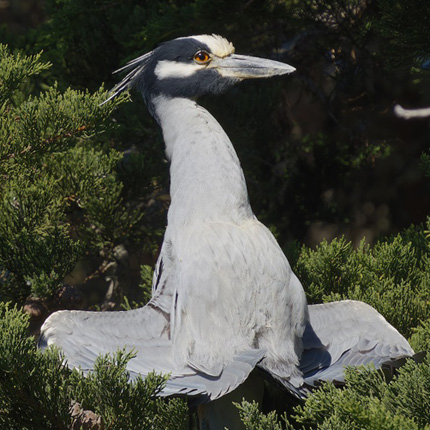
By 14 November, "Nick" was back at his usual spot in Pebble Beach. As our sunny fall weather lingered into December, he was documented sun-basking (lower left, 12 Dec, © Mark Chappell). On a foggy 20th of December while he was awake at mid-day and craning his neck, an instant photo (below right) was taken. Nick took flight to a different roost, and then another, and then 10 minutes later, flew to last cypress in the row, adjacent to the Stillwater Cove pier. If all continues well, we can expect him to winter in Pebble Beach as still the only Yellow-crowned Night Heron to occur in MTY.
|
|
|
| |
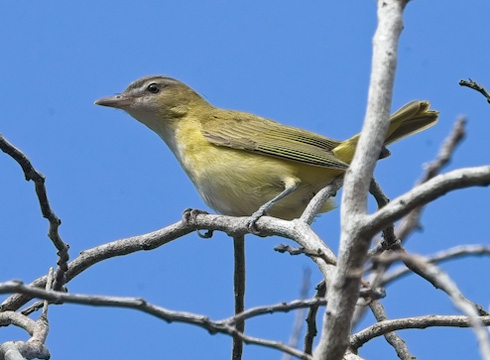
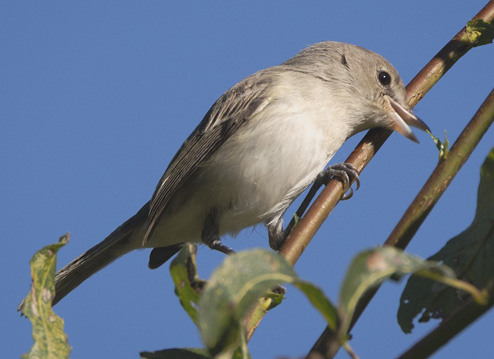 While Sep-Oct brought an expected assortment of "eastern" and "southwestern" vagrant warblers, the overall numbers and diversity this fall were fewer than in some other recent autumns. Rather, what was impressive this fall were rare vireos. The best was a Bell's Vireo photographed by Jeff Barnum on 3 Oct and identified that evening. It remained at the east end of Laguna Grande Park, Seaside, through 5 Oct (photo left, 3 Oct, © Jeff Barnum). While Sep-Oct brought an expected assortment of "eastern" and "southwestern" vagrant warblers, the overall numbers and diversity this fall were fewer than in some other recent autumns. Rather, what was impressive this fall were rare vireos. The best was a Bell's Vireo photographed by Jeff Barnum on 3 Oct and identified that evening. It remained at the east end of Laguna Grande Park, Seaside, through 5 Oct (photo left, 3 Oct, © Jeff Barnum).
This wonderfully active little bird was a "Least" Bell's Vireo Vireo bellii pusillus, an endangered subspecies, now breeding only in southern California and in Baja California, Mexico. This subspecies is much grayer than the subspecies in Arizona and the East. It once had a few breeding pairs north to southern Monterey County, but none has been found since the 1990s. Thereafter, only a handful of vagrants have occurred in MTY. This Laguna Grande bird was the first "Least" Bell's Vireo for the Monterey Peninsula area. [There was an "eastern" Bell's Vireo at Pt. Pinos on 14-17 Oct 2018.]
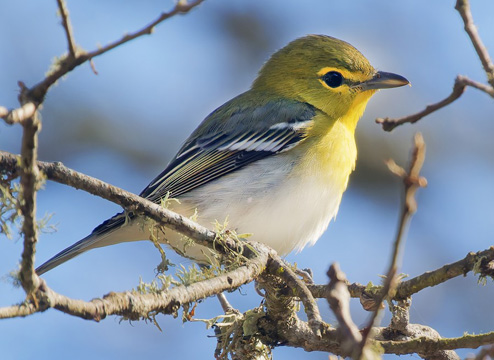
The next vireo of note was Yellow-green Vireo. Three were found during the first two weeks of October: 2-5 Oct at Laguna Grande (found by Paul Fenwick); 4 Oct at Frog Pond (Lucas Corneliussen); and 14 Oct at Point Lobos State Reserve (Tom Clifton). Each was documented with photos, but the most unexpected was the Pt. Lobos bird (below left, © Tom Clifton). In the past, Yellow-green Vireo was discovered occasionally during the fall, and usually with many years passing between occurrences. In contrast, four different Yellow-greens were located in Sep-Oct 2021, and two more in fall 2022. The three this year brings the MTY total to 23 records.
The final rare vireo was a Yellow-throated Vireo, found by Terence Degan at a vacant lot with oaks at Belden and Drake, Monterey. Apparently a residence will soon be built on this lot. But for 2025, birders reaching the location soon after it was posted had nice views (photo below right, © Mark Chappell). This rarity occurs in spring and fall migration, and occasionally in summer. This year's find was the 16th for MTY. |
|
| |
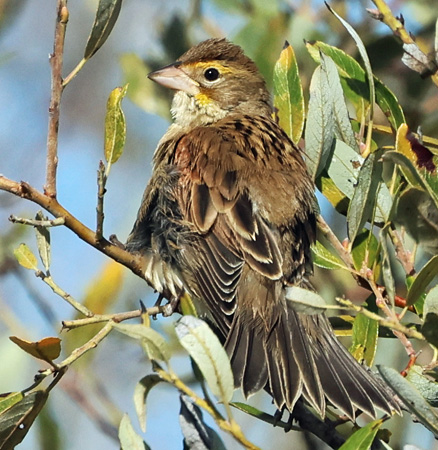
On 30 September, two unexpected birds appeared at Laguna Grande Park in Seaside. A Dickcissel was found by Kai Russel at the "Russian bridge," where it frequented the reeds, bathed in the creek, and then dried out in the sun (ph near right © Don Roberson). We only average one a year.
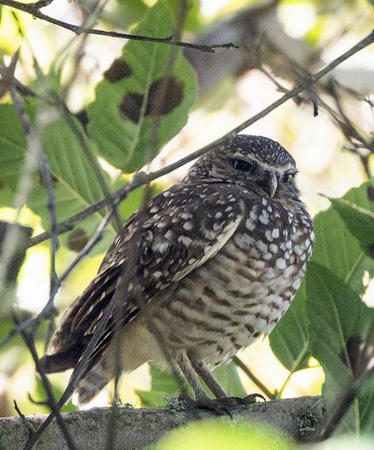
Kai also saw an in-flight Burrowing Owl. Amazingly, a few hours later and independently, Rita Carratello found that Burrowing Owl at a perch high in an alder tree where it remained for almost an hour (ph far right Jeff Barnum). It is the only record ever for Laguna Grande. |
 |
 |
|
In MTY, early fall 2025 was sunny, dry and warm, with passerine migration peaking in Sep-Oct. It also coincided with returning rarities:
- the Tropical Kingbird present for its 7th consecutive winter at Laguna Grande, returned this fall on 20 Sep 2025, and continued into January. There were 2-3 other Tropical Kingbirds at Laguna Grande in late September (and sometimes interactive and calling), so it can be difficult to tell which one was "the" returning individual. Carole & Larry Rose found the one on 20 Sep, and its behavior — especially its choice of perches around the lake — suggested that this was, most likely, the returning individual. As in prior years, it would occasionally visit Roberts Lake, during its prolonged stay.
- "George," a hybrid or intergrade Western x Glaucous-winged Gull, present at Laguna Grande for its 14th consecutive winter, was there 7 Oct 2025 through year's end.
|
SIDEBAR
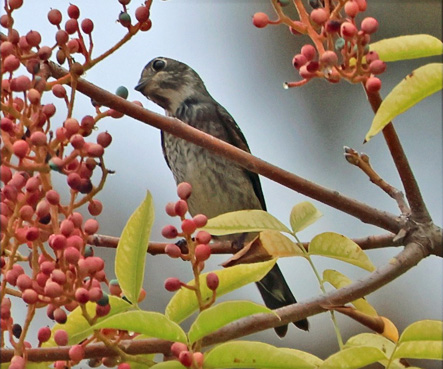
In mid-September, Santa Clara County hosted a Dark-sided Flycatcher (Muscicapa sibirica) in Palo Alto. The species breeds north into Siberia (sometimes called "Siberian Flycatcher") and migrates to southeast Asia. This was an unexpected first for California and for the lower continental 48 states! Such a "mega" rarity was chased by birders from across the continent. It was found on a Wednesday (17 Sep), but only Bay Area observers got there that day. During the next two days (18-19 Sep), members of the Monterey and Santa Cruz birding communities made it to the Google parking lot, where the Old World flycatcher sometimes foraged in fruiting Chinese Pistache trees (ph right, 18 Sep © Don Roberson). Alas, it left before the weekend. Looking at eBird lists, I think at least 14 of the MTY birders made this successful pilgrimage. |
 |
|
| |
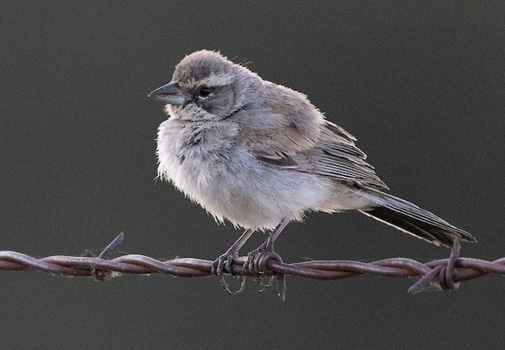
Perhaps the best passerine vagrant of the fall season was this imm Black-throated Sparrow among a loose flock of Lark Sparrows in Little Peachtree Valley by Brian Sullivan and Chris Wood, on 5 Sep 2025 (ph left, © Brian L. Sullivan). Certainly this remote southeastern corner is sparsely covered in fall migration. Prior vagrant Black-throated Sparrows have been along the coast in September, and one in May. The only other inland occurrence was one netted at Hastings Natural History Reserve in upper Carmel Valley on 13 Sep 1989. |
 |
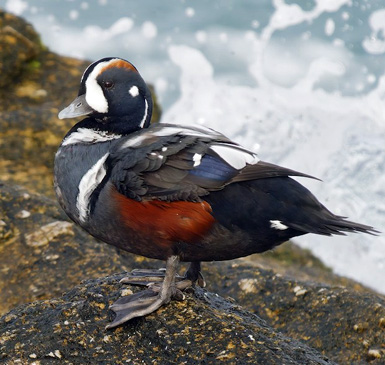 |
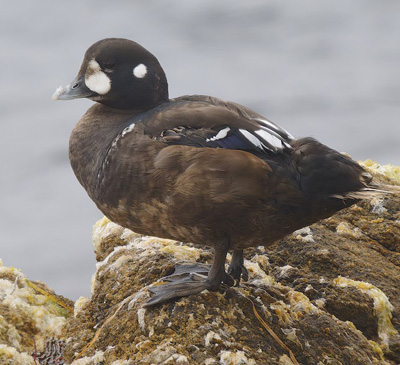
A male Harlequin Duck wintered at Bird Rock, Pebble Beach, and then undertook a full eclipse molt, presumably with a flightless period, starting in July and completed in September. By October it was fully resplendent again. Mark Chappell documented all stages of this molt. Shown here, at left, was the Harlequin Duck on 8 August and on 1 October (both © Mark Chappell). |
|
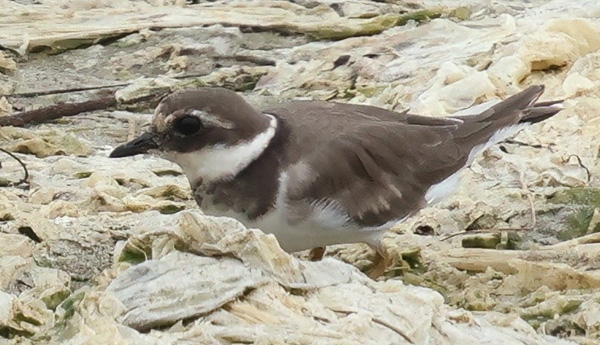 Despite the excellent set of waders from June through August, discussed below, the shorebird season would be crowned by yet another major rarity along Jetty Road in Moss Landing: an adult Common Ringed Plover discovered by Steve Tucker on 29 Sep (photo left, 29 Sep, © Steve Tucker). It was almost always with Semipalmated Plovers, in flocks from 30 to 270, foraging at low tide but roosting at high tide in Moss Landing harbor or on Moss Landing SB. It had worn upperwing coverts when discovered (photo left), but had an extensive body molt over the autumn. It was still present at year's end. Despite the excellent set of waders from June through August, discussed below, the shorebird season would be crowned by yet another major rarity along Jetty Road in Moss Landing: an adult Common Ringed Plover discovered by Steve Tucker on 29 Sep (photo left, 29 Sep, © Steve Tucker). It was almost always with Semipalmated Plovers, in flocks from 30 to 270, foraging at low tide but roosting at high tide in Moss Landing harbor or on Moss Landing SB. It had worn upperwing coverts when discovered (photo left), but had an extensive body molt over the autumn. It was still present at year's end.
Identification was difficult for most birders because of similarities to Semipalmated Plover, but Common Ringed Plover has a longer bill, a broader loral patch extending to the bill, lacks webbing between the central and inner toes, and has a different call (but not often heard). This is the 4th record for MTY. The preceding three were found in fall 2023 and 2024 in wastewater ponds inland, including an adult that wintered 2024-2025 and returned in autumn 2025. |
| |
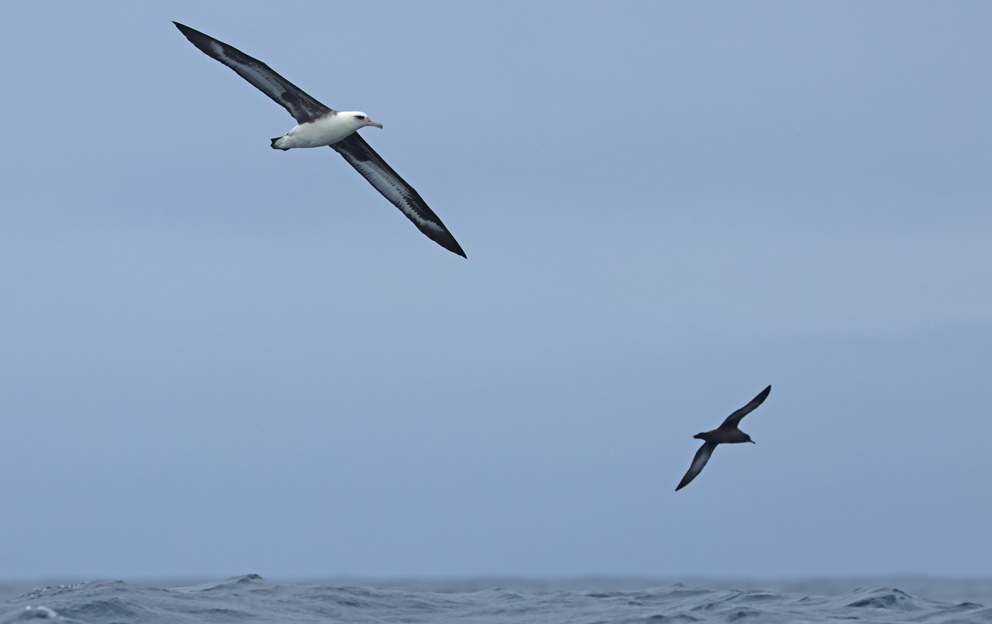 |
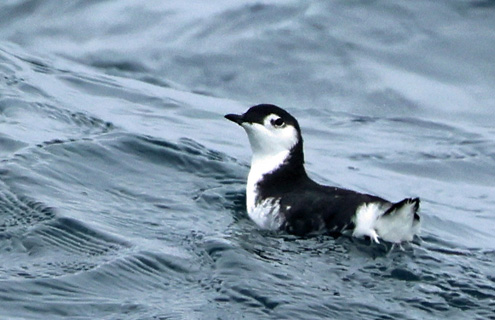
Monterey Bay and offshore waters from July into October were generally warmer than average. Guadalupe Murrelet — usually the scarcest of Synthliboramphus murrelets in MTY — were present in numbers from research cruises far offshore in July, and others were spotted on public pelagic trips into September (right, 28 Sep © Don Roberson). Laysan Albatross used to be found mostly on winter boat trips, but now they can occur in any month, as exemplified by this one 20 miles west of Pt. Sur, with a Sooty Shearwater, on 28 Sep (above, © Don Roberson).
Seawatchers at Pt. Pinos this autumn recorded a pair a Scripps's Murrelet on 24 Sep (Scott Terrill, Gene Revelas), a half-dozen South Polar Skua from 13 Sep to 22 Dec (the latter one very late, Catherine Webb), and a Streaked Shearwater scoped on 11 October (Brian Sullivan, Paul Fenwick). |
 |
|
| |
|
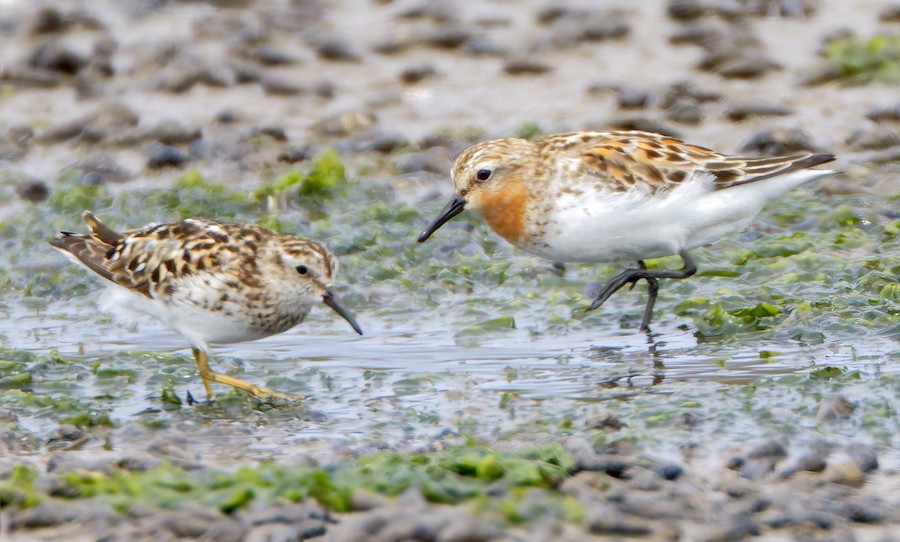
| Although the run of diverse waders at Asilomar SB was a great time for locals, fall migration's best shorebird was a breeding-plumaged Red-necked Stint along Jetty Road in Moss Landing, found and first reported by visitor Jay Withgott on 20 July. Since this was a continental rarity, eager birders arrived from far and near. One visitor, Keaton Schneeflock, was spurred to look through the photos he had taken on Jetty Road on 19 July — and he discovered he had inadvertently photographed the Red-necked Stint as well! So its entire stay turned out to be 19-21 July 2025. The Red-necked Stint would forage at low tide with hundreds of other small Calidris sandpipers, and could be hard to find and photograph. The photo I like best is this one (above) by Mark Chappell, shows it near a breeding-plumaged Least Sandpiper (photo 21 July, © Mark Chappell). This is just the second record for MTY; the first was in the Moss Landing salt ponds on 13-14 July 2001 (see Plate 7 in Monterey Birds, 2d ed., Roberson 2002). |
|
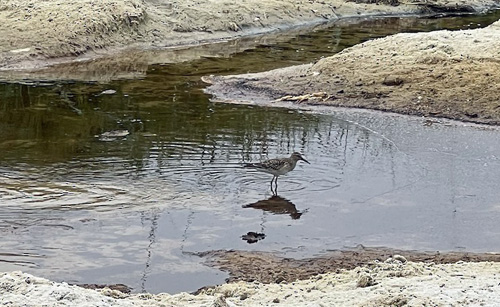
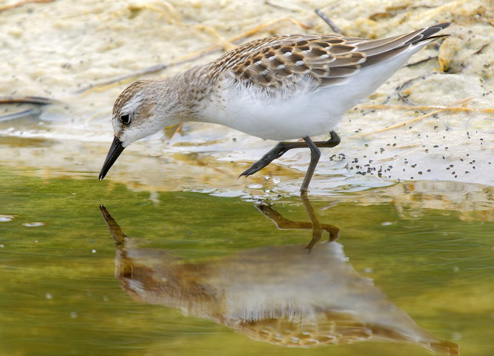
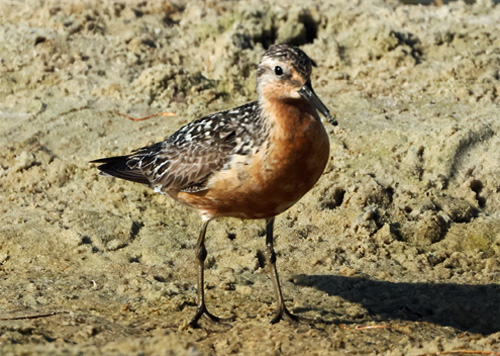
| In June, two rare White-rumped Sandpipers were found in MTY (for details, see the highlights of the first half of 2025). The first White-rumped was at a tiny pool created by the outflow of Majella Creek mouth on the sandy Asilomar State Beach. Since then, starting in July and again in August, local birders were seen pointing cameras at that same puddle (photo below left from June, © D. Roberson). That's because other rarities stopped at this tiny pool of freshwater. One example was this Pectoral Sandpiper (below right, on 20 Aug, ph © Rita Carratello, showing the size of this pool). Scarcer shorebirds at this spot in July included a juvenile Semipalmated Sandpiper from 24-27 July (2d row below, left; ph 24 July © Mark Chappell) and a breeding-plumaged Red Knot, found by Kai Russell, on 28 July (2d row below, right, ph 28 July © Don Roberson). |
|
| |
Literature cited:
- Roberson, D. 2002. Monterey Birds, 2d ed. Monterey Audubon Soc., Carmel, CA.
- Roberson, D., and C. Tenney, ed. 1993. Atlas of the Breeding Birds of Monterey County, California. Monterey Audubon Soc., Carmel, CA.
I thank Rita Carratello and Michael Rieser for editorial comments on an earlier draft of this page.
|
|
Page created 20 Dec 2025-9 Jan 2026
TOP
GO TO
HOME PAGE
TO MONTEREY
COUNTY
PAGE
TO BIRD
FAMILIES
OF THE WORLD
|